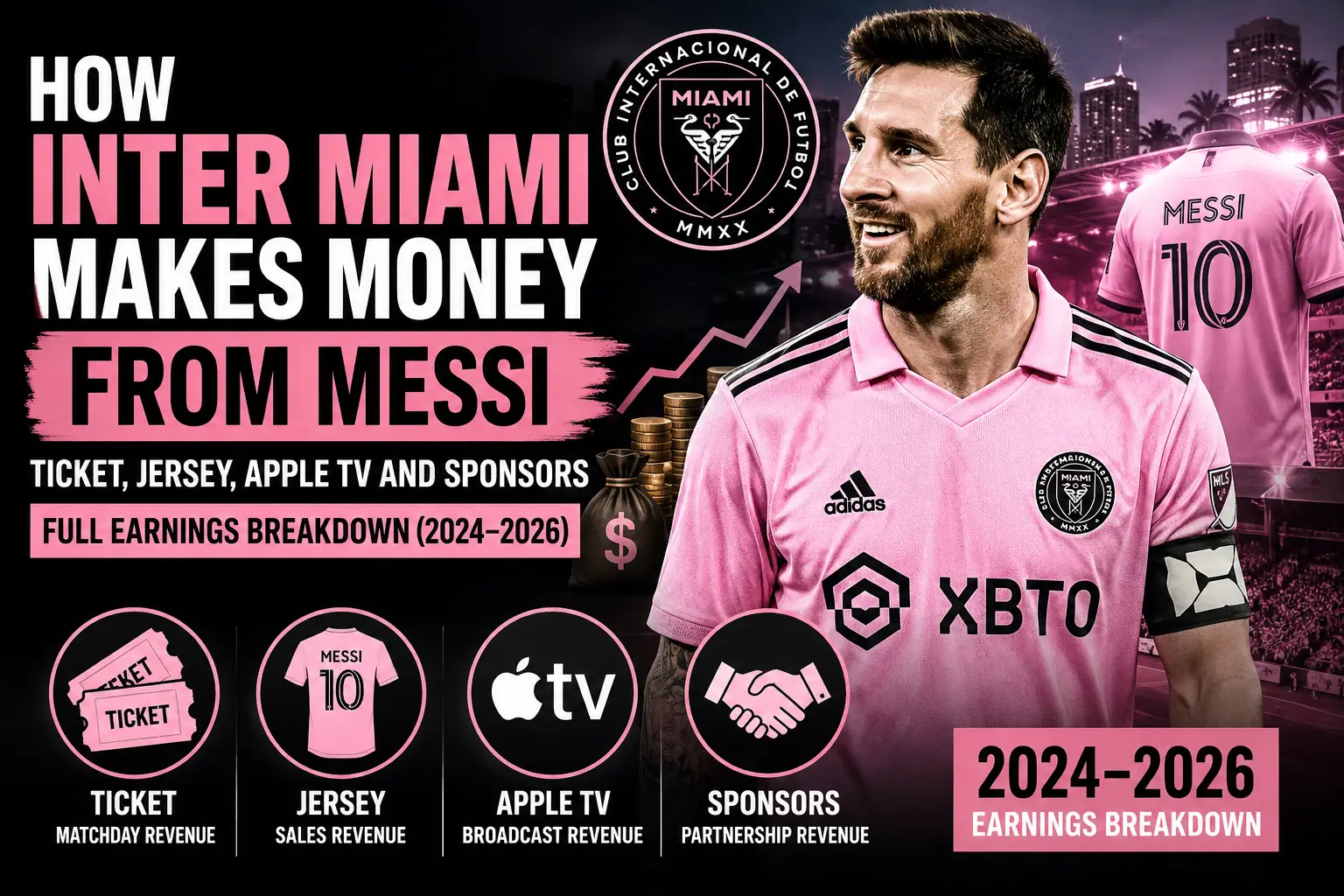
Lionel Messi’s arrival at Inter Miami in July 2023 transformed the club into one of the most talked-about teams in world football. His performances attracted millions of new fans, increased demand for match tickets, boosted merchandise sales, and helped the club secure major sponsorship agreements. By 2024, Inter Miami had become a powerful commercial brand in American soccer.
But how does Inter Miami actually make money from Messi? The answer goes far beyond selling tickets to watch one of the world’s greatest footballers. The club benefits from higher matchday spending, sponsorship agreements, merchandise demand, international tours, and the growing popularity of Major League Soccer (MLS). Apple and Adidas also play important roles in the wider commercial ecosystem surrounding Messi.
This article examines the main revenue sources connected to Messi from 2024 through 2026, explaining what is known about the numbers, how the business model works, and why his commercial influence extends beyond the football pitch.
1. The Messi Effect: How Inter Miami’s Revenue Grew
Before Messi joined the club, Inter Miami was still building its identity and commercial presence. His arrival dramatically increased international attention, giving the team access to a much larger audience.
According to Sports Business Journal, Inter Miami generated approximately $125 million in revenue in 2023, while club executives expected revenue to exceed $200 million in 2024. Forbes later estimated that the club generated $180 million in revenue in 2024. These figures are estimates or reported financial expectations, not a complete audited breakdown of Messi-specific income.
The growth demonstrates how one globally recognized player can transform a sports organization’s commercial potential.
Messi helped Inter Miami attract more spectators, sell more merchandise, negotiate valuable sponsorships, and reach supporters in countries where MLS previously received less attention.
The club also became more attractive to commercial partners because companies could use its connection with Messi to promote products to a worldwide audience.
The key point is that Inter Miami does not earn all the money associated with Messi directly. Some revenue belongs to the club, some belongs to MLS, and some goes to commercial partners such as Adidas and Apple under their respective agreements.
2. Ticket Sales: One of the Biggest Revenue Sources
Match tickets are among the most direct ways Inter Miami benefits financially from Messi.
When Messi plays, fans have an opportunity to watch a global football icon in person. This creates strong demand for tickets, particularly for important matches and games against popular opponents.
Higher Ticket Prices
Following Messi’s arrival, ticket prices increased as demand grew. Sports Business Journal reported that the club’s cheapest season-ticket price rose from $485 for 2023 to $884 for 2024.
The price increase illustrates how much more fans were willing to pay to attend matches.
Single-game tickets can also become considerably more expensive on the resale market. However, resale prices are not the same as the amount received by Inter Miami. A resale seller may keep much of the additional money, depending on the platform and transaction fees.
More Matchday Spending
Tickets are only part of the matchday business. Fans attending games may also purchase:
- Food and drinks
- Team shirts and other merchandise
- Premium seating packages
- Parking and other matchday services
These purchases can increase the economic value of each home match.
Inter Miami’s stadium capacity also limits how many tickets the club can sell for an individual game. Consequently, increasing demand does not automatically mean the club can sell unlimited additional seats.
Does Every Ticket Dollar Go to Inter Miami?
Not necessarily. Ticket revenue may involve taxes, fees, stadium operating costs, and other expenses. The club’s actual financial benefit depends on the event’s arrangements and operating costs.
Nevertheless, Messi’s ability to attract larger crowds and support premium pricing has made ticket sales an important part of Inter Miami’s commercial growth.
3. Jersey Sales and Merchandise Revenue
Messi’s famous number 10 shirt has become one of the most recognizable products associated with Inter Miami.
The club’s pink kit attracts attention because of its distinctive design, while Messi’s international popularity encourages supporters to purchase shirts bearing his name and number.
MLS reported in 2024 that Messi ranked first among the league’s top-selling player jerseys. The league also reported that merchandise sales on MLSstore.com had increased by 17% compared with the previous year.
These results demonstrate the strength of demand for MLS merchandise after Messi arrived.
How Jersey Sales Generate Money
When a fan purchases an official Inter Miami shirt, the transaction can benefit several businesses.
The retailer receives the sale proceeds before accounting for its expenses. Adidas manufactures and supplies the kit under its arrangements with MLS and the club. Inter Miami may receive revenue or other commercial benefits under its merchandise agreements.
The exact distribution depends on licensing contracts, production arrangements, retail margins, and other terms that are not all publicly available.
This means it would be misleading to assume that Inter Miami receives the entire retail price of every Messi shirt sold.
More Than Football Shirts
Messi’s popularity can also encourage purchases of:
- Training shirts
- Scarves and hats
- Jackets and other apparel
- Collectibles and officially licensed accessories
These products help turn short-term excitement into a broader merchandise business.
However, the total number of shirts sold and the club’s net profit from those sales are different figures. Manufacturing costs, retailer margins, licensing fees, and distribution expenses all affect the final financial result.
4. Apple TV and MLS Season Pass
Apple is another important part of the commercial story surrounding Messi.
Apple and MLS entered a 10-year global streaming partnership that began in 2023. The arrangement gave fans access to MLS matches through Apple’s streaming platform, with MLS Season Pass serving as the league’s dedicated subscription service during its initial seasons.
Messi’s arrival helped attract additional international attention to this service.
How Messi Helped Streaming Demand
Before Messi joined Inter Miami, MLS had a smaller international audience than some of the world’s leading football competitions. His presence gave supporters in Argentina, Europe, and other regions a compelling reason to follow the league.
Sports Business Journal reported that MLS Season Pass experienced substantial subscriber growth following Messi’s debut. Apple executives also acknowledged that the service’s audience became more international after his arrival.
This demonstrates Messi’s commercial value beyond ticket sales and shirt purchases.
Does Inter Miami Receive All the Apple Revenue?
No. The streaming agreement is a league-level commercial arrangement, rather than a simple payment made entirely to Inter Miami.
MLS and Apple have their own contractual relationship. The financial benefits of that agreement must be distinguished from the money earned by an individual club.
Messi also reportedly negotiated an arrangement giving him a share tied to international MLS Season Pass subscriptions. The complete contractual terms and resulting payments have not been publicly disclosed.
For Inter Miami, the wider benefit comes from greater international visibility, increased interest in the club, and the potential to attract more fans and commercial partners.
Important distinction: Subscriber growth does not automatically equal an equal increase in Inter Miami’s revenue. Subscription prices, promotional offers, league agreements, and revenue-sharing arrangements all influence the financial outcome.
5. Sponsorship Deals: The Biggest Commercial Opportunity
Sponsorship agreements are among the most important ways Inter Miami turns Messi’s popularity into business revenue.
International companies want their brands to appear alongside famous athletes because sports sponsorship can increase brand awareness, attract customers, and create emotional connections with supporters.
Messi’s arrival made Inter Miami more attractive to businesses looking to reach football fans in the United States and overseas.
Royal Caribbean: The Front-of-Shirt Sponsor
Royal Caribbean became Inter Miami’s front-of-shirt sponsor in 2024. Its logo appears prominently on the club’s playing shirts, giving the company visibility during matches, television coverage, interviews, and promotional activities.
The partnership was reported as the largest sponsorship agreement in MLS history at the time.
Although the complete financial terms were not publicly disclosed, the deal demonstrated how Messi’s presence helped Inter Miami negotiate commercially valuable partnerships.
Chase Stadium Naming Rights
Another important commercial relationship involves JPMorgan Chase.
The club’s stadium in Fort Lauderdale became known as Chase Stadium in 2024. Stadium naming-rights agreements provide companies with continuing brand exposure, including through match coverage, event promotions, and news reports.
These agreements are valuable because they can extend beyond a single match or season.
Other Commercial Partners
Inter Miami has also developed relationships with other companies, including Fracht Group, Duracell, and additional regional and international partners.
These agreements may involve shirt sponsorships, advertising, promotional campaigns, and other commercial activities.
In February 2024, Sports Business Journal reported that Inter Miami expected sponsorship revenue to approach $60 million for the season, approximately double the amount generated the previous year.
This was a reported expectation, rather than a final audited figure for every sponsorship agreement.
The broader lesson is that Messi does not need to appear in every advertisement for the club to benefit. His presence can increase the commercial appeal of the entire team, making its sponsorship inventory more valuable.
6. International Tours and Exhibition Matches
International tours offer another opportunity for Inter Miami to benefit from Messi’s worldwide popularity.
When a club featuring a global superstar travels abroad, organizers can attract spectators, television audiences, commercial partners, and media attention.
Inter Miami’s preseason schedule in early 2024 included matches and appearances in several international markets, including Saudi Arabia, Hong Kong, and Japan.
These trips helped the club reach fans outside the United States while creating opportunities to build relationships with potential sponsors.
How International Tours Make Money
The financial benefits can come from several sources:
- Match appearance fees
- Commercial partnerships associated with the tour
- Promotional and marketing agreements
- Merchandise sales
- Increased international brand exposure
However, not every international match produces the same financial result. Travel expenses, accommodation, player availability, event arrangements, and contractual obligations can affect profitability.
The exact amount Inter Miami earned from each tour has not been comprehensively disclosed.
Even when a tour’s direct profit is limited, international exposure may provide longer-term benefits by introducing the club to new audiences.
7. Messi’s Influence on Inter Miami’s Brand Value
A football club’s value is not determined solely by its annual income. Its brand recognition, commercial partnerships, fan base, stadium plans, and future earning potential also matter.
Messi significantly increased Inter Miami’s international visibility.
According to Forbes’ 2025 MLS valuations, published in February 2025, Inter Miami was valued at approximately $1.2 billion, making it one of the most valuable teams in the league.
The valuation reflects the club’s broader business prospects rather than a direct calculation of Messi’s individual contribution.
Why Brand Value Matters
A stronger brand can help a club negotiate better sponsorship agreements, attract investors, sell premium experiences, and develop new commercial opportunities.
Inter Miami can also use its growing reputation to build a larger supporter base that remains interested in the club beyond individual matches.
However, a club valuation is not the same as cash in the bank. It represents an estimate of what the business may be worth, not money that the club can automatically spend.
The long-term challenge is maintaining this commercial strength through sporting success, supporter engagement, and investment in facilities and the club’s wider business operations.
8. Inter Miami’s Messi-Related Earnings: 2024–2026 Breakdown
The following table summarizes the principal financial figures reported during this period. It separates club-wide revenue estimates from individual commercial indicators.
| Revenue Category | Reported Figure or Indicator | What It Means |
|---|---|---|
| 2023 club revenue | Approximately $118–125 million, depending on the reported estimate | Revenue increased substantially after Messi arrived midway through the season. |
| 2024 club revenue | Forbes estimated $180 million | Reflects the club’s overall business, not Messi-specific income alone. |
| 2024 revenue target | More than $200 million expected by club executives | A forecast reported before the season’s final financial results were known. |
| 2024 sponsorship target | Nearly $60 million expected | Demonstrates the commercial demand for partnerships with Inter Miami. |
| Ticket sales | Season-ticket prices increased for 2024 | Higher demand allowed the club to charge more for many ticket packages. |
| Merchandise | Messi ranked first among MLS’s top-selling player jerseys in 2024 | Shows strong consumer demand for Messi-branded club merchandise. |
| Apple and MLS Season Pass | Increased international attention and reported subscriber growth | Benefits the wider league’s streaming business; it is not all Inter Miami revenue. |
| 2025 club valuation | Approximately $1.2 billion, according to Forbes | An estimated business valuation, not annual revenue or profit. |
| 2026 financial results | Complete Messi-specific figures are not publicly established here | Exact revenue from tickets, merchandise, streaming, and sponsorships should not be invented. |
Important: These figures come from different reports and use different measurement methods. They should not be added together to calculate a total because some are forecasts, some are revenue estimates, and others describe commercial performance or business valuation.
What About 2025 and 2026?
By 2025, Messi’s influence extended beyond the initial excitement surrounding his arrival. Inter Miami had established a stronger international brand, continued attracting commercial attention, and benefited from sustained interest in its matches and merchandise.
In October 2025, Inter Miami announced a contract extension keeping Messi at the club through the 2028 season. This gave the club a longer period in which to build commercial plans around his presence.
For 2026, the important distinction is between an ongoing commercial opportunity and a verified financial result. Ticket prices, merchandise demand, sponsor agreements, and audience figures can change from year to year.
Without a complete, reliable breakdown of the club’s 2026 financial results, it would be misleading to assign precise dollar amounts to each Messi-related revenue stream.
9. How Much Profit Does Inter Miami Actually Make From Messi?
Revenue and profit are two different things.
Revenue is the money a business generates before deducting its expenses. Profit is what remains after the relevant costs have been accounted for.
Inter Miami must pay players and staff, operate its facilities, organize matches, maintain its commercial operations, and meet other financial obligations.
Messi’s contract is also a major expense. Sports Business Journal reported that his original agreement involved compensation estimated at $50 million to $60 million annually, including salary, signing bonuses, and equity-related components. That estimate should not be treated as a simple annual cash salary.
The club’s business model aims to make Messi’s commercial contribution greater than the costs associated with signing and supporting him.
In 2025, Forbes estimated Inter Miami generated $180 million in revenue and $50 million in operating income in 2024. These are publication estimates, not an official, publicly audited calculation of Messi’s individual profitability.
The figures nevertheless illustrate why the signing was considered a major commercial success.
Ultimately, Messi’s value comes from the combined effect of ticket demand, merchandise, sponsorships, international attention, and the growth of Inter Miami as a sports business.
10. What Happens to Inter Miami’s Business After Messi?
Messi will not play professional football forever, so the club must think beyond the period when he is an active player.
A sustainable business strategy involves turning temporary excitement into lasting supporter loyalty.
Inter Miami can work toward that goal by investing in youth development, strengthening its squad, improving the matchday experience, expanding its commercial partnerships, and developing its stadium and surrounding business operations.
The club can also continue building its identity around South Florida’s football culture rather than depending entirely on one individual.
Messi has given Inter Miami an extraordinary commercial advantage. The next challenge is using that advantage to establish a successful club that remains attractive to fans and sponsors in the future.
Conclusion
Lionel Messi has transformed Inter Miami’s commercial position through his extraordinary global popularity. His arrival helped increase ticket demand, strengthen merchandise sales, attract major sponsors, and expand international interest in MLS.
Ticket sales and sponsorships are particularly important to the club’s business, while merchandise and international exposure provide additional commercial opportunities. Apple’s streaming partnership has helped expand the league’s global reach, although its revenue must be distinguished from Inter Miami’s own earnings.
The reported financial figures show substantial growth, but they do not provide a complete breakdown of every dollar generated directly by Messi.
For Inter Miami, the real achievement is not simply selling more tickets or shirts. It is turning Messi’s popularity into a stronger, more valuable, and potentially more sustainable football business.
Frequently Asked Questions (FAQs)
1. How much money does Inter Miami make from Messi?
Inter Miami’s overall revenue increased substantially after Messi arrived. Forbes estimated the club generated $180 million in revenue in 2024. However, this figure represents the entire club’s business, not money earned exclusively because of Messi.
2. Does Inter Miami earn money from Messi jersey sales?
Yes, the club can benefit from merchandise sales through its commercial and licensing arrangements. However, Adidas, retailers, and other partners may receive portions of the revenue. The exact amount Inter Miami earns from each Messi shirt is not publicly established.
3. How does Apple TV help Inter Miami make money?
Apple’s streaming partnership has helped expand MLS’s international reach, with Messi attracting additional interest in the league. Inter Miami benefits indirectly through increased visibility and commercial opportunities, but the streaming agreement’s revenue is not paid entirely to the club.
4. Which is Inter Miami’s biggest revenue source connected to Messi?
Matchday revenue and sponsorships are among the most important commercial sources. Matchday revenue includes tickets and related spending, while sponsorships provide payments for advertising and commercial partnerships. Their exact ranking and individual contributions can vary by season.
5. How much money did Inter Miami make from Messi between 2024 and 2026?
A complete, verified total for 2024–2026 is not publicly established here. Reported figures include Forbes’ estimate of $180 million in overall club revenue for 2024, but a reliable total would require comparable financial results for all three years and a clear separation of Messi-related revenue from other club income.