
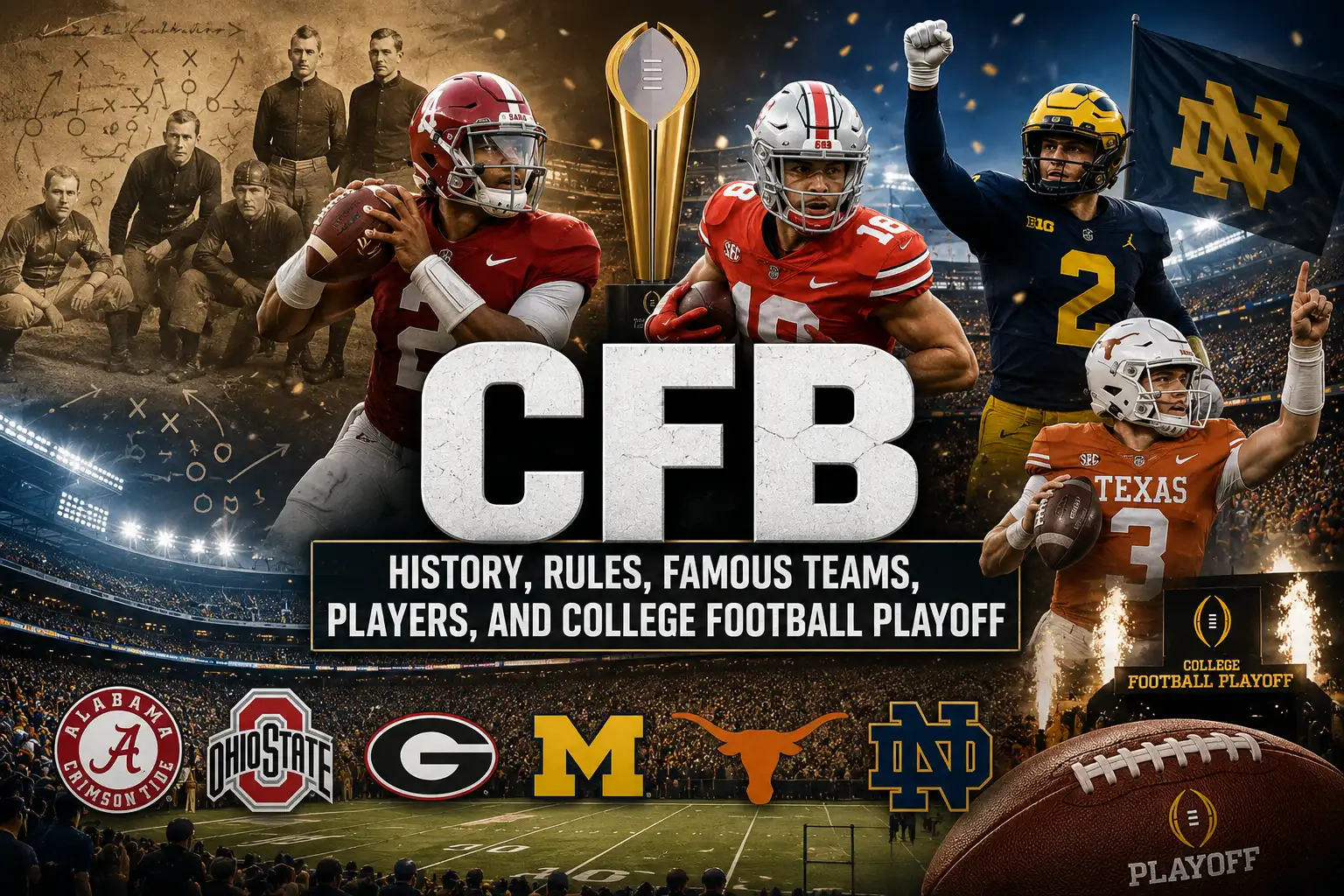
College football, commonly known as CFB, is one of the most popular sports in the United States. It combines athletic skill, teamwork, school traditions, and intense rivalries. Every season, millions of fans watch their favorite college teams compete for conference championships and a place in the College Football Playoff. From historic stadiums to exciting rivalry games, college football offers unforgettable moments for players and supporters.
CFB also plays an important role in developing future professional football stars. Many famous NFL players first gained national attention while representing their universities. For students, alumni, and sports fans, college football is more than a game. It is a tradition that brings communities together.
In this guide, we explore the history of college football, its basic rules, famous teams, legendary players, major competitions, and what makes the sport so exciting.
What Is CFB?
Image prompt: A wide-angle view of an American college football game in a packed stadium, with players wearing helmets and uniforms, green field, goalposts, and cheering fans. No text or logos.
CFB stands for college football, a form of American football played by teams representing colleges and universities. Most major programs compete under the National Collegiate Athletic Association (NCAA), although college football also includes other organizations and divisions.
The highest level of NCAA college football is the Football Bowl Subdivision (FBS). It features many well-known universities and attracts enormous television audiences. Another level, the Football Championship Subdivision (FCS), also offers competitive football and its own championship system.
Each team represents its school and competes against other universities during the season. Games are played in stadiums that can hold tens of thousands of spectators. Fans wear school colors, sing traditional songs, and celebrate victories together.
The sport is especially popular in states such as Alabama, Texas, Georgia, Ohio, and Michigan. However, college football has supporters throughout the country.
The History of College Football
Image prompt: A historical collage showing an early American college football game alongside a modern college football stadium, illustrating the sport’s evolution.
College football has a long history in the United States. The first intercollegiate football game commonly recognized in the sport’s history took place on November 6, 1869, between Rutgers and Princeton. The rules were very different from those used in modern American football.
During the late nineteenth and early twentieth centuries, the game gradually developed into a more recognizable form. Rules changed to improve organization and safety, while universities established teams and competitions.
The forward pass became legal in 1906, helping transform offensive strategies. Over time, protective equipment improved, and coaching became more specialized.
Radio broadcasts helped introduce college football to a wider audience. Television later made it possible for fans across the country to follow major games. Bowl games and conference championships also became important parts of the college football calendar.
In recent decades, the sport has undergone significant changes involving television contracts, athlete compensation opportunities, conference realignment, and postseason competition. The College Football Playoff has created a national championship pathway for leading FBS teams.
Today, CFB combines more than a century of tradition with modern tactics, advanced training, and a growing national audience.
Basic Rules of College Football
Image prompt: An educational sports photograph showing college football players lined up before a snap, with the referee and yard lines visible on the field.
Understanding the basic rules makes college football easier to follow. The objective is to score more points than the opposing team before the game ends.
A standard game consists of four quarters, each lasting 15 minutes at the major college level. The clock can stop for certain events, so the actual game takes considerably longer than 60 minutes.
The offense has four downs to gain at least 10 yards. If it succeeds, it receives a new set of four downs. If it fails, possession may change to the opposing team, depending on the situation and the team’s decision.
Teams can advance the ball by running with it or throwing a forward pass. Players can also kick the ball to change field position or attempt to score.
The main scoring methods are:
- Touchdown: Six points for carrying the ball into the opponent’s end zone or catching a legal pass there.
- Extra point: Usually one point after a touchdown when the team kicks through the goalposts.
- Two-point conversion: Two points for successfully reaching the end zone from a short distance after a touchdown.
- Field goal: Three points for a successful kick through the goalposts during a play.
- Safety: Two points awarded to the defense in certain situations when the offense is tackled or commits a qualifying violation in its own end zone.
Penalties can result in lost yards, automatic first downs, or other consequences. Officials enforce the rules and determine whether plays are legal.
Famous College Football Teams
Image prompt: A college football stadium filled with fans during a major rivalry game, with players from two teams facing each other before kickoff. Use generic uniforms without official logos.
College football features numerous historic programs with large fan bases and proud traditions. Some schools are known for championship success, while others are famous for their rivalries, stadium atmosphere, or ability to develop professional players.
The Alabama Crimson Tide is one of the sport’s most successful programs, with a long record of major achievements. The Ohio State Buckeyes also have a rich tradition and strong national following.
The Georgia Bulldogs have enjoyed major success in the modern era, while the Michigan Wolverines are famous for their history, enormous stadium, and rivalry with Ohio State.
The Texas Longhorns are recognized for their passionate supporters and distinctive school traditions. The Notre Dame Fighting Irish have a national following built through decades of memorable performances.
Other prominent programs include the Oklahoma Sooners, LSU Tigers, Penn State Nittany Lions, Florida Gators, Oregon Ducks, and USC Trojans.
Each program offers a different atmosphere. Some teams rely on powerful running attacks, while others are known for explosive passing offenses or aggressive defenses.
These rivalries and traditions make every season special. A victory against a longtime opponent can be just as memorable to fans as winning a major championship.
Legendary College Football Coaches
Image prompt: A generic American college football coach standing on the sideline with a headset, clipboard, and players in the background during a competitive game.
Coaches have played a major role in shaping college football. They develop strategies, train players, build team culture, and prepare their programs for important games.
Nick Saban became one of the most successful coaches in modern college football through his championship-winning career at Alabama and earlier achievements at LSU. His teams were known for discipline, preparation, and strong performances on both sides of the ball.
Bear Bryant is another legendary figure. He led Alabama for many years and became famous for his leadership, competitive teams, and influence on the sport.
Woody Hayes helped establish Ohio State as a national power, while Bobby Bowden built Florida State into a leading program during his coaching career.
Tom Osborne guided Nebraska through a highly successful period, and Urban Meyer won national championships with Florida and Ohio State.
Great coaches often leave a lasting impact beyond wins and losses. Their systems influence future coaches, while their former players carry lessons about preparation, teamwork, and leadership into professional football.
Modern college coaching also involves recruiting, transfer-portal management, player development, sports science, and media responsibilities. Successful programs must combine tactical knowledge with the ability to adapt to a changing college sports environment.
Famous College Football Players
Image prompt: An American college football quarterback preparing to throw a pass, with teammates protecting him and a packed stadium in the background. Use generic uniforms and no identifiable real person.
College football has introduced many outstanding athletes to the sporting world. Some became professional superstars, while others are remembered for their college achievements and influence on their universities.
Tim Tebow became a celebrated Florida quarterback, winning major honors and helping his team achieve national success. His leadership and physical playing style made him a memorable college athlete.
Cam Newton produced an extraordinary season at Auburn in 2010, leading the Tigers to a national championship and winning the Heisman Trophy.
Reggie Bush dazzled fans at USC with his speed and versatility. His college career remains one of the most discussed in the sport’s history.
Joe Burrow led LSU to an outstanding 2019 season, setting major passing records and earning the Heisman Trophy before entering the NFL.
Caleb Williams became a prominent college quarterback at Oklahoma and USC before moving to professional football.
Other notable college stars include Archie Griffin, the only player to win the Heisman Trophy twice, and Bo Jackson, remembered for his remarkable athletic ability at Auburn.
The Heisman Trophy is one of college football’s most prestigious individual awards. It is presented annually to the player judged to be the most outstanding in cfb.
Although individual awards attract attention, football remains a team sport. Offensive linemen, defensive players, special-teams specialists, and other teammates all contribute to success.
College Football Conferences
Image prompt: Two college football teams competing in a packed stadium during a conference game, with the referee and midfield markings visible.
Conferences organize many college football teams and provide regular-season competition. Teams often play several conference opponents each year, creating familiar rivalries and helping determine conference champions.
Major FBS conferences include the Southeastern Conference (SEC), Big Ten Conference, Atlantic Coast Conference (ACC), and Big 12 Conference. Other conferences include the American Athletic Conference, Conference USA, Mid-American Conference, Mountain West, and Sun Belt.
Conference membership has changed over time as universities have moved between leagues. These changes can affect traditional rivalries, travel schedules, television coverage, and the strength of each conference.
The SEC is famous for its passionate fan bases and highly competitive teams. The Big Ten has a long history and several major programs. The ACC has produced many successful teams, while the Big 12 features exciting matchups and varied offensive styles.
Conference games are especially important because teams are competing not only for wins but also for standings, championship opportunities, and postseason recognition.
The College Football Playoff
Image prompt: A dramatic college football postseason game under stadium lights, with players entering the field and fans holding signs in the stands.
The College Football Playoff (CFP) determines the national champion at the highest level of college football. It replaced the previous four-team playoff format with a 12-team structure beginning with the 2024 season.
The expanded format gives more leading teams a chance to compete for the national title. Selection considers factors such as team performance, schedule strength, conference championships, and other criteria established by the playoff selection committee.
The playoff features a combination of first-round games, quarterfinals, semifinals, and a national championship game. Some teams receive first-round byes, while others must win additional games to advance.
The postseason has become one of the most exciting parts of the calendar. Every game can determine whether a team’s championship hopes continue or end.
The playoff also creates opportunities for teams outside the traditional group of championship favorites. Strong performances during the regular season can help a program earn national recognition and a place in the postseason.
Fans follow playoff rankings closely because even a single loss or a major victory can influence the national championship picture.
College Football Rivalries and Traditions
Image prompt: A college football rivalry game with packed stands, marching-band members, school-color decorations, and energetic fans.
Rivalries are among the biggest reasons attracts such passionate supporters. Many matchups have developed over decades, creating traditions passed from one generation to the next.
The Michigan Wolverines versus Ohio State Buckeyes rivalry is one of the sport’s most famous annual contests. The Alabama Crimson Tide and Auburn Tigers also compete in an intense rivalry known as the Iron Bowl.
Other major matchups include Texas versus Oklahoma in the Red River rivalry and Army versus Navy, a game associated with military traditions and national attention.
College football traditions include marching bands, tailgate parties, school songs, mascots, and pregame ceremonies. Supporters often travel long distances to attend major games.
These customs give college football a distinctive identity. The experience is not limited to the action on the field; it also includes school pride, community connections, and shared memories.
For many alumni, attending games is a way to remain connected to their universities long after graduation.
How College Football Develops Future NFL Stars
Image prompt: College football players training on a practice field with coaches, footballs, cones, and tackling equipment visible in the background.
College football is an important pathway to the National Football League (NFL). Many professional players spend several seasons developing their skills at universities before entering the NFL Draft.
College programs provide coaching, strength and conditioning, tactical instruction, and competitive experience. Players learn to read defenses, understand offensive systems, improve their movement, and perform under pressure.
The NFL Draft allows professional teams to select eligible players. A strong college season can improve a player’s reputation, although draft success depends on several factors, including skill, health, position, and team also provides opportunities for athletes to build leadership and communication skills. Players must balance training, team responsibilities, travel, and academic requirements.
Not every talented college player becomes an NFL star, but the college system has helped develop many of the league’s most recognizable athletes.
Why College Football Is So Popular
Image prompt: A packed American college football stadium at night, with the field illuminated, fans cheering, and players preparing for a key play.
remains popular because it combines competition with tradition and community identity. Fans often support the same university for their entire lives, creating a strong emotional connection to the team.
The atmosphere at major games is another major attraction. Large crowds, marching bands, dramatic entrances, and close finishes make an exciting live experience.
The sport also offers unpredictable results. Underdog teams can challenge highly ranked opponents, and unexpected performances can change a season’s direction.
Television and digital media allow supporters to follow games, highlights, interviews, rankings, and analysis from almost anywhere. Social media also helps fans discuss performances and share memorable moments.
College football continues to evolve as conferences, broadcasting agreements, player compensation, and postseason structures change. Despite these developments, the excitement of representing a university remains central to the sport.
For new fans, learning the rules and following a favorite team is an excellent way to appreciate the strategy and traditions of CFB.
The Future of College Football
Image prompt: A modern stadium with digital scoreboards, a coaching staff reviewing tactics, and players warming up before kickoff.
The future of will be shaped by technology, athlete opportunities, conference changes, and the growth of digital broadcasting. Video analysis and performance data already help coaches prepare more detailed strategies.
Changes in athlete compensation and transfer rules have also influenced recruiting and roster management. Programs must now adapt to a college sports environment in which players have more opportunities to change schools and benefit financially from their name, image, and likeness.
The expanded playoff has increased the number of teams that can pursue a national championship. This may create more competitive postseason matchups and help new programs attract national attention.
At the same time, preserving historic rivalries and protecting player welfare will remain important challenges. Fans want exciting games, but they also value the traditions that make college football unique.
As the sport continues to develop, its combination of athletic talent, school pride, and intense competition is likely to remain a major part of American sports culture.
Frequently Asked Questions (FAQs) About CFB
1. What does CFB stand for?
CFB stands for College Football. It is a popular American sport played by college and university teams across the United States.
2. Which are the most popular college football teams?
Some of the most popular teams include the Alabama Crimson Tide, Ohio State Buckeyes, Georgia Bulldogs, Michigan Wolverines, Texas Longhorns, and Notre Dame Fighting Irish.
3. How does the College Football Playoff work?
The College Football Playoff determines the national champion at the highest level of college football. Since the 2024 season, it has featured 12 teams competing through a series of postseason games.
4. How many minutes are in a college football game?
A standard college football game consists of four quarters, each lasting 15 minutes. However, the complete game usually takes around three to four hours because of breaks, timeouts, and other stoppages.
5. Can college football players join the NFL?
Yes. Eligible college football players can enter the National Football League (NFL) Draft. Many professional football stars developed their skills while playing for college teams.