
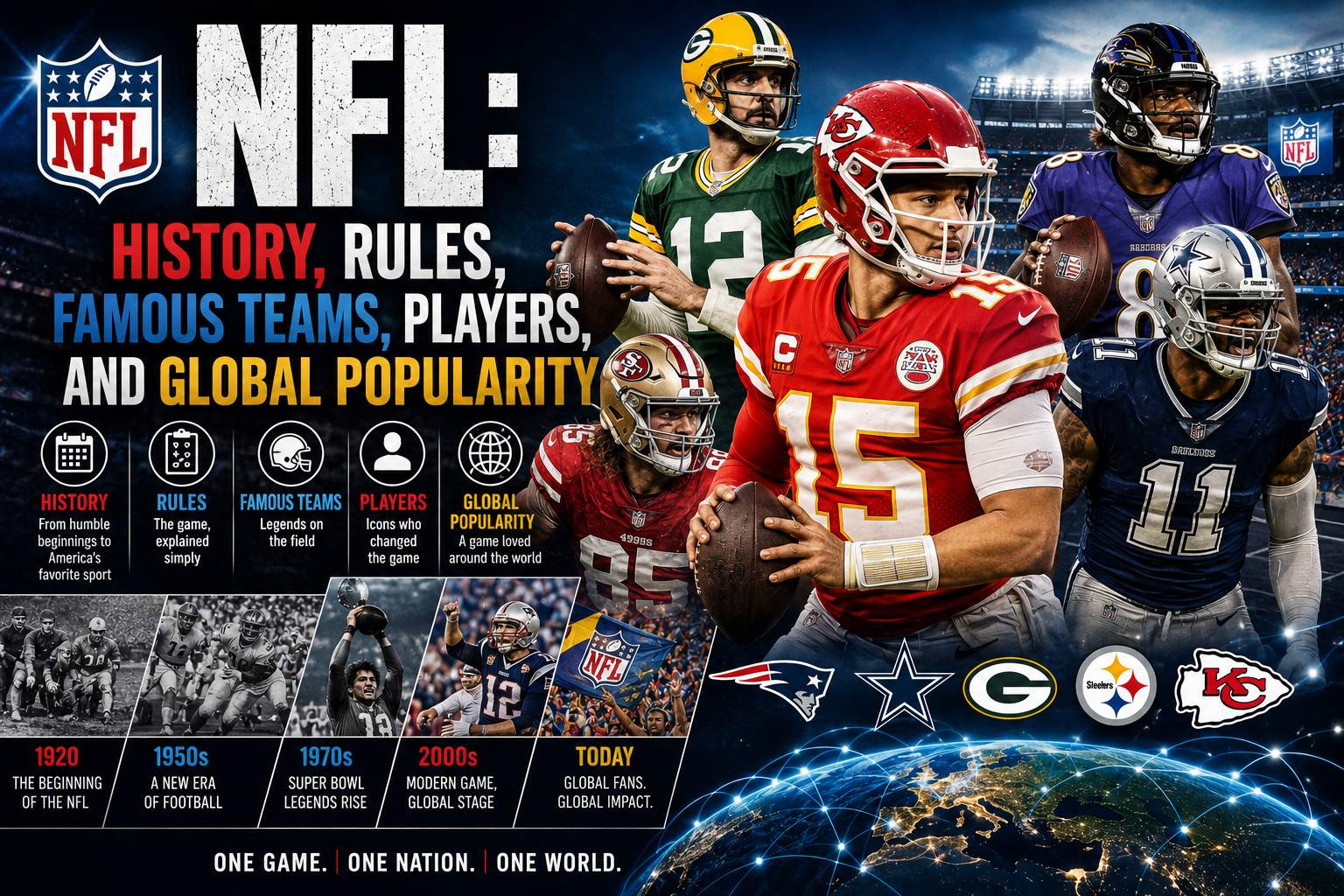
Introduction
The National Football League (NFL) is one of the most popular professional sports leagues in the United States. It is famous for exciting matches, powerful athletes, impressive strategies, and the incredible atmosphere of its stadiums. Millions of fans watch NFL games every week, while many more follow their favorite teams through television, websites, and social media.
The NFL is the highest level of professional American football. It brings together talented players, experienced coaches, and 32 teams that compete throughout the season for the chance to win the Super Bowl. The league is also a major part of American culture, with football games becoming important events for families, communities, and sports lovers.
Over the years, the NFL has developed from a small professional competition into a major sports organization with international audiences. Its popularity continues to grow because of thrilling games, famous players, modern technology, and the excitement of the Super Bowl. This article explores the history of the NFL, its rules, teams, famous players, major events, and worldwide influence.
1. What Is the NFL?

The National Football League is a professional American football league based in the United States. It is made up of 32 teams that compete for the league championship each season.
The NFL operates through two conferences: the American Football Conference (AFC) and the National Football Conference (NFC). Each conference contains 16 teams, divided into four divisions with four teams in each division.
The league’s main goal is to determine the best team in professional American football. Teams compete during the regular season and then try to qualify for the playoffs. The successful teams advance through the postseason until two teams meet in the Super Bowl.
The NFL is known for its physical competition, tactical planning, skilled quarterbacks, powerful defensive players, and dramatic finishes. Every game requires teamwork, discipline, preparation, and quick decision-making.
2. History of the NFL

The NFL was founded in 1920 under the name American Professional Football Association (APFA). It was established in Canton, Ohio, and initially included a small group of professional football teams. In 1922, the organization adopted the name National Football League.
During its early years, the NFL faced several challenges. Professional football was not as popular as college football, and teams often struggled financially. However, the league gradually improved its organization, attracted talented players, and gained more supporters.
In the 1930s and 1940s, the NFL introduced important changes to its competition and rules. Championship games helped create greater interest, while improved organization made professional football more competitive.
Television played a major role in the league’s growth during the 1950s and 1960s. Fans could watch games from their homes, allowing the NFL to reach people far beyond stadiums. The 1958 NFL Championship Game between the Baltimore Colts and New York Giants became particularly memorable because of its dramatic overtime finish.
In 1966, the NFL agreed to merge with its rival, the American Football League (AFL). The merger was completed in 1970 and helped shape the modern league. The first AFL-NFL World Championship Game was played in January 1967 and later became known as Super Bowl I.
Since then, the NFL has expanded its commercial reach, improved broadcasting, developed new rules, and attracted audiences around the world.
3. Basic Rules of NFL Football

American football can look complicated to beginners, but its basic rules are easy to understand.
The Objective of the Game
The main objective is to score more points than the opposing team. Teams move an oval-shaped football toward the opponent’s end zone by running with the ball or passing it forward.
Number of Players
Each team has 11 players on the field at one time. Teams have separate offensive and defensive units, along with special teams that participate in kicking plays.
Game Duration
An NFL game consists of four quarters, each lasting 15 minutes of game time. The clock can stop for certain situations, so an actual game often lasts around three hours or longer.
Downs and First Downs
The offense usually has four downs, or attempts, to advance the ball at least 10 yards. If the team gains those 10 yards, it earns a new first down and another set of four attempts.
If the offense fails to gain enough yards, possession usually goes to the opponent, although teams may choose to punt or attempt a field goal on fourth down.
Scoring System
The NFL uses several ways to score points:
- Touchdown — 6 points: A player carries the ball into the opponent’s end zone or catches a pass there.
- Extra point — 1 point: A successful kick after a touchdown.
- Two-point conversion — 2 points: A successful play from near the goal line after a touchdown.
- Field goal — 3 points: A successful kick through the opponent’s goalposts.
- Safety — 2 points: Awarded to the defense when specific conditions are met, commonly when the ball carrier is tackled in their own end zone.
Understanding these rules makes watching NFL games much easier and more enjoyable.
4. NFL Teams and Conferences

The NFL has 32 teams divided equally between the AFC and NFC. Each team represents a city or region and has its own colors, logo, history, and loyal supporters.
American Football Conference (AFC)
The AFC includes teams such as the Kansas City Chiefs, Buffalo Bills, Baltimore Ravens, Cincinnati Bengals, Pittsburgh Steelers, New England Patriots, Miami Dolphins, and Denver Broncos.
Other AFC teams include the Houston Texans, Indianapolis Colts, Jacksonville Jaguars, Tennessee Titans, New York Jets, Cleveland Browns, Los Angeles Chargers, and Las Vegas Raiders.
National Football Conference (NFC)
The NFC includes famous teams such as the Dallas Cowboys, San Francisco 49ers, Philadelphia Eagles, Green Bay Packers, Chicago Bears, and New York Giants.
The remaining teams are the Detroit Lions, Minnesota Vikings, Atlanta Falcons, Carolina Panthers, New Orleans Saints, Tampa Bay Buccaneers, Arizona Cardinals, Los Angeles Rams, Seattle Seahawks, and Washington Commanders.
Each conference contains four divisions: East, North, South, and West. Divisions create regional rivalries and help determine which teams qualify for the playoffs.
Some rivalries have continued for decades, attracting passionate supporters whenever the teams meet. These rivalries are an important part of the NFL’s identity.
5. The NFL Regular Season and Playoffs
The NFL season is divided into several stages. Each stage brings different challenges and opportunities for the teams.
Preseason
The preseason takes place before the regular season. Teams use these games to evaluate players, test strategies, and prepare for competitive matches. Coaches often give opportunities to younger players who want to earn a place on the main roster.
Regular Season
The regular season determines which teams qualify for the playoffs. Under the current format, each team plays 17 regular-season games over 18 weeks, with one bye week.
Every win is important because teams compete for division titles and playoff positions. A strong performance throughout the season can provide an advantage in the postseason.
Playoffs
The playoffs are a knockout competition involving 14 teams: seven from the AFC and seven from the NFC. Teams must win their postseason games to advance.
The division winners and wild-card qualifiers compete in the Wild Card round, followed by the Divisional round and conference championship games. The two conference champions then advance to the Super Bowl.
The playoff system creates excitement because a single defeat can end a team’s championship hopes.
6. The Super Bowl: The Biggest NFL Event

The Super Bowl is the championship game of the NFL and one of the biggest annual sporting events in the United States. It brings together the AFC champion and NFC champion to decide the league’s champion.
The first Super Bowl was played in January 1967. Since then, the event has developed into a major celebration of sports, entertainment, advertising, and American culture.
Millions of people watch the game on television and digital platforms. Many fans organize parties, prepare special meals, wear their team’s jerseys, and gather with friends and family.
The Super Bowl halftime show is another major attraction. Famous musicians and performers entertain viewers during the break, helping the event appeal to people who may not regularly watch football.
Commercials shown during the broadcast also receive considerable attention. Companies often spend large amounts of money to advertise their products because of the game’s enormous audience.
Winning the Super Bowl is the ultimate achievement for an NFL team. The victorious team receives the Vince Lombardi Trophy, named after the legendary coach Vince Lombardi.
7. Famous NFL Players

Throughout its history, the NFL has produced many outstanding athletes. Some became famous for their passing ability, while others earned recognition for running, defense, leadership, or longevity.
Tom Brady
Tom Brady is widely regarded as one of the greatest quarterbacks in NFL history. He won seven Super Bowl championships during his career, six with the New England Patriots and one with the Tampa Bay Buccaneers.
His preparation, leadership, and performances in important games made him a central figure in modern NFL history.
Patrick Mahomes
Patrick Mahomes is known for his powerful arm, creativity, mobility, and ability to make difficult passes. As quarterback of the Kansas City Chiefs, he has helped lead the team to multiple Super Bowl championships.
His playing style has attracted younger fans and demonstrated how quarterbacks can adapt to changing defensive strategies.
Jerry Rice
Jerry Rice is considered one of the greatest wide receivers in football history. He became famous for his catching ability, route-running skills, discipline, and remarkable consistency.
His career achievements helped establish him as a standard of excellence for players at his position.
Peyton Manning
Peyton Manning was celebrated for his intelligence, accuracy, and ability to understand defensive formations. He won two Super Bowl championships and became one of the most respected quarterbacks of his generation.
Lawrence Taylor
Lawrence Taylor changed the way many people viewed defensive football. His speed, strength, and ability to pressure quarterbacks made him one of the most influential defensive players in NFL history.
These athletes represent different eras and positions, showing that success in football depends on many forms of skill and teamwork.
8. Famous and Successful NFL Teams

Several NFL teams have built strong reputations through championships, historic players, and loyal fan bases.
- New England Patriots: Known for their highly successful era under coach Bill Belichick and quarterback Tom Brady.
- Pittsburgh Steelers: Famous for their strong defensive traditions and multiple Super Bowl victories.
- Dallas Cowboys: Often called “America’s Team,” they are among the league’s most recognizable franchises.
- San Francisco 49ers: Known for championship success and legendary players across different generations.
- Green Bay Packers: A historic franchise with a distinctive community-owned structure and passionate supporters.
- Kansas City Chiefs: Became a major force in the modern NFL through their success with quarterback Patrick Mahomes and coach Andy Reid.
- Philadelphia Eagles: Known for their dedicated supporters and memorable championship achievements.
Each franchise has its own story, traditions, and rivalries. These differences help make the league interesting throughout the season.
9. Important Positions in NFL Football

Every NFL team depends on players performing different roles. Understanding these positions helps fans appreciate the strategy behind each play.
Quarterback (QB): The quarterback leads the offense, receives the ball at the start of most offensive plays, and usually passes or hands it to another player.
Running Back (RB): Running backs carry the ball, attempt to gain yards, and may also catch passes.
Wide Receiver (WR): Wide receivers run routes to get open and catch passes from the quarterback.
Tight End (TE): Tight ends combine receiving skills with blocking responsibilities.
Offensive Line: These players protect the quarterback and create space for running backs.
Defensive Line: Defensive linemen try to stop running plays and pressure the opposing quarterback.
Linebackers: Linebackers help defend against both running and passing plays.
Defensive Backs: Cornerbacks and safeties cover receivers, defend passes, and attempt to prevent big gains.
Special Teams: These players participate in kickoffs, punts, field goals, and extra-point attempts.
All these positions must work together. Even a talented individual cannot consistently win without effective teamwork and communication.
10. NFL Coaching and Game Strategy
Coaching is one of the most important parts of professional football. Coaches prepare players, study opponents, design plays, and make decisions during games.
Offensive coaches develop strategies to move the ball and score points. Defensive coaches prepare their teams to stop opponents, force turnovers, and protect the end zone. Special-teams coaches focus on kicking and returning the ball.
Before a game, coaching staff study video recordings of previous matches to identify weaknesses in the opposing team. They consider player strengths, formations, weather conditions, and possible situations that could occur.
During a match, coaches adjust their plans according to the score, time remaining, and performance of both teams. Decisions about whether to punt, attempt a field goal, or go for a first down can have a major effect on the final result.
This strategic element makes the NFL more than a physical contest. It is also a game of planning, analysis, and decision-making.
11. NFL Stadiums and Fan Culture

NFL stadiums are among the most recognizable venues in American sports. They host thousands of supporters who gather to cheer for their favorite teams.
Fans wear team jerseys, wave flags, display banners, and participate in chants. Many supporters follow their teams for generations, making football an important family tradition.
Some stadiums have distinctive histories and atmospheres. Lambeau Field, home of the Green Bay Packers, is particularly famous for its longstanding traditions and cold-weather games. AT&T Stadium, home of the Dallas Cowboys, is known for its enormous video screen and modern facilities.
Tailgating is another popular tradition in which fans gather outside stadiums before games. They enjoy food, music, conversation, and friendly competition.
These traditions create a sense of community and help explain why the NFL has such a devoted following.
12. Technology and Innovation in the NFL
Technology has changed how NFL games are played, officiated, analyzed, and watched.
Television broadcasts use multiple camera angles, slow-motion replays, and detailed graphics to help viewers understand important plays. Digital platforms allow fans to follow games, check statistics, and watch highlights on their devices.
Teams also use video analysis and performance data to evaluate players and develop strategies. Coaches can study formations, passing patterns, and defensive movements to prepare for upcoming opponents.
Replay review helps officials examine certain important decisions. The league also uses technology to support player tracking and improve the analysis of movement on the field.
Player safety has become another important area of innovation. Changes to equipment, tackling rules, training practices, and medical procedures aim to reduce the risk of injuries. However, football remains a physically demanding sport, and injury prevention continues to be a significant challenge.
Technology has made the NFL more accessible to fans while helping teams make better-informed decisions.
13. NFL Popularity Around the World
Although the NFL began and developed primarily in the United States, its audience has expanded internationally. Fans in countries such as the United Kingdom, Germany, Mexico, Canada, and Brazil have shown interest in American football.
The league has organized regular-season games outside the United States, giving international supporters opportunities to watch professional teams compete in their own countries.
International broadcasts, social media, online highlights, and streaming services have also helped introduce the sport to new audiences.
For people who are unfamiliar with American football, learning the rules and following a favorite team can make the sport easier to understand. Famous athletes, competitive matches, and the Super Bowl provide natural starting points for new fans.
The NFL also supports international events and programs intended to develop interest in the sport. Its long-term international growth depends on making games accessible and helping new audiences understand its unique style of competition.
14. Economic Importance of the NFL
The NFL has a major economic impact through broadcasting, sponsorships, ticket sales, merchandise, and stadium events.
Television and streaming agreements allow broadcasters to show games to large audiences. Businesses pay to sponsor teams, advertise during broadcasts, and connect their brands with professional football.
Teams also earn revenue from ticket sales, hospitality services, and merchandise such as jerseys, hats, and other products.
NFL games can benefit local economies by attracting visitors who spend money on hotels, restaurants, transport, and entertainment. Major events such as the Super Bowl can generate significant business activity for their host cities.
The league also provides employment opportunities for athletes, coaches, medical professionals, stadium workers, journalists, broadcasters, and many other professionals.
However, the financial success of a major sporting league does not mean every team, business, or host community benefits equally. The overall economic impact depends on factors such as event costs, local spending, and how revenue is distributed.
15. Challenges Facing the NFL
Despite its success, the NFL faces several important challenges.
Player safety: Football involves physical contact, and players can suffer serious injuries. Concussions and other head injuries have raised concerns about the long-term effects of repeated impacts. The league continues to adjust rules and safety practices, but risks remain.
Competition for viewers: The NFL competes with other sports, video games, streaming platforms, and digital entertainment for people’s attention.
Changing technology: Fans increasingly expect flexible viewing options, reliable streaming, and easy access to statistics and highlights.
Maintaining competitive balance: Teams need effective management, coaching, and player development to remain competitive. League rules and salary regulations are designed in part to help maintain a fair competition.
Expanding internationally: American football has complicated rules and requires specialized equipment, so introducing it to new audiences can take time.
Addressing these challenges is important for the league’s future. Continued attention to player welfare, accessibility, and fan experience can help preserve public interest in the sport.
16. The Future of the NFL
The future of the NFL will likely be shaped by technology, international growth, player development, and changes in how fans consume sports.
Digital streaming and interactive broadcasts may make it easier for viewers to follow their favorite teams. Advanced statistics and improved camera systems could provide deeper insights into individual performances and tactical decisions.
International games may introduce the league to more supporters, while youth football programs can help develop future athletes. The league will also need to continue examining player safety and improving the way injuries are prevented and managed.
As new players emerge and teams develop new strategies, the competition is likely to remain exciting for long-time supporters and newcomers alike.
The NFL’s ability to balance entertainment, sporting excellence, and player welfare will play an important role in its continued success.
Conclusion
The National Football League is much more than a professional football competition. It is a major sports organization with a rich history, famous teams, legendary players, and a passionate international audience.
From its beginnings in 1920 to the modern era of global broadcasting, the NFL has grown through competitive games, strategic innovation, and memorable championship moments. Its rules, player positions, coaching strategies, and playoff system create a unique sporting experience that attracts millions of fans.
The Super Bowl remains the highlight of the season, while historic franchises and outstanding athletes continue to shape the league’s identity. At the same time, the NFL must address player safety, technological changes, and the challenge of reaching new audiences.
With its combination of athletic ability, teamwork, strategy, and entertainment, the NFL is likely to remain one of the world’s most recognizable professional sports leagues for years to come.